

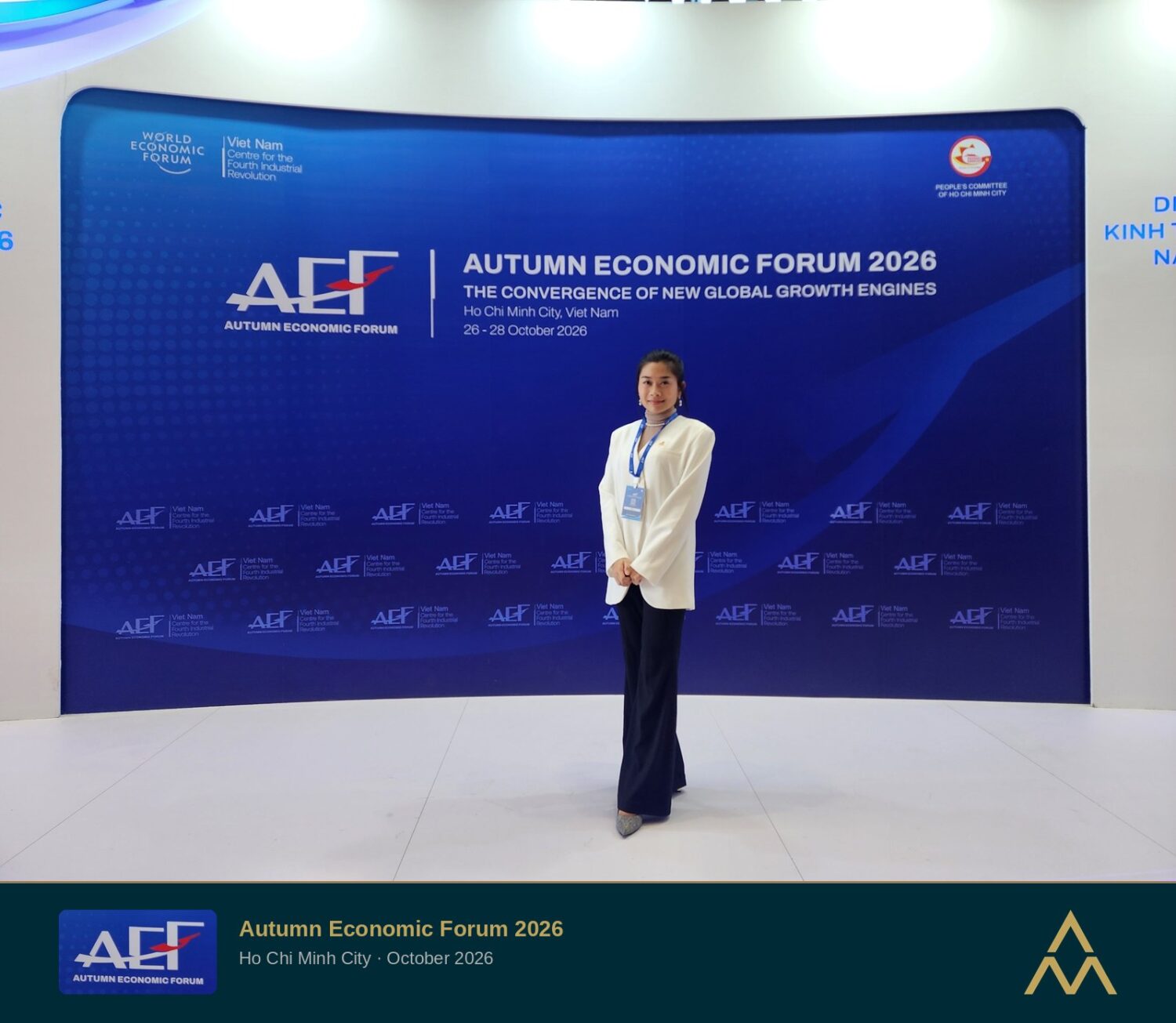
When economies across the region are competing for the same pools of capital, technology and talent, what makes one city a convergence point rather than one more stop on an investor’s itinerary? That question ran through the Autumn Economic Forum 2026 (AEF 2026), held in Ho Chi Minh City in late October under the positioning “The Convergence of New Global Growth Engines” and the theme “The Spirit of Cooperation in a New Era”. Hosted by the Ho Chi Minh City People’s Committee and organised by the city’s Centre for the Fourth Industrial Revolution (HCMC C4IR), this year’s edition brought together more than 1,500 delegates from 60 countries and territories, and for the first time in the forum’s history its two main days were co-branded with the World Economic Forum.
Alliance Mount Group was represented by Linh Doan, Managing Director, who attended the forum’s main programme as a delegate. As an advisory firm working on M&A, restructuring and capital raising in Vietnam, we followed the sessions closest to our work: the shifting direction of foreign capital, the build-out of the Vietnam International Financial Centre, and the policy signals from the high-level plenary.
The clearest takeaway was that Vietnam’s conversation with international investors is moving from opportunity to infrastructure: the institutions, licences and market mechanisms that determine whether capital can actually be deployed.
A forum built around capital, technology and policy
The programme opened on 26 October with CEO 500 – TEA CONNECT, a dialogue between city leaders, ministries and the international business community framed around “New Perspectives on FDI – Technology – Global Financial Flows”. The following day the forum split into 16 thematic sessions across three tracks: AI and quantum; finance, the digital economy and autonomy; and manufacturing, sustainability and the next generation. The main forum days of 27 and 28 October took place at the Thiskyhall Sala Convention Centre.
Placed in the wider context, the structure itself said something. A few years ago, a forum of this kind in Vietnam would likely have centred on the country’s cost advantages and its place in manufacturing supply chains. AEF 2026 gave equal weight to finance and digital infrastructure, which reflects a shift toward the question of how capital is channelled and governed once it arrives, not only how it is attracted.
Finance and the digital economy: from interest to readiness
On 27 October, the finance, digital economy and autonomy track examined the frameworks behind cross-border digital and financial activity. At a panel on policy frameworks for the digital economy, speakers argued that ASEAN needs national systems that can work together while still protecting data.
The most concrete development came on the morning of 28 October, when the Vietnam International Financial Centre in Ho Chi Minh City (VIFC-HCMC) recognised ten holding companies as its first official members, with Prime Minister Le Minh Hung in attendance. According to published reports, the founding members have indicated a combined investment commitment of around USD 2.7 billion for 2026–2027. On the sidelines the same day, Deputy Prime Minister Nguyen Van Thang, who chairs the VIFC Executive Council, asked the centre to accelerate bank licensing, with the aim of admitting its first member bank and executing the first transactions in November.
From an investment perspective, this is the stage where an international financial centre is no longer an announcement but an operating question. The first members are holding companies; the next steps the authorities described involve licensing, legal frameworks and specialised financial institutions, starting with investment funds. For investors and companies considering cross-border structures, the practical details of these rules, rather than the headline, will shape what is actually possible.
The plenary: positioning Vietnam for the next phase
The high-level plenary on 28 October, “The Convergence of New Global Growth Engines”, was followed by a dialogue between Prime Minister Le Minh Hung and World Economic Forum Managing Director Stephan Mergenthaler on positioning Vietnam in the global future. The Prime Minister described 2026–2030 as a pivotal period for the country’s ambition of becoming a developed, high-income nation by 2045, and outlined four priorities for cooperation with the WEF and international partners.
Closing the main forum, Nguyen Van Duoc, Chairman of the Ho Chi Minh City People’s Committee, framed the city’s approach to cooperation as moving beyond one-off deal matching toward strategic network links and the shaping of value chains. He set out three priorities for the city: institutional reform and pilot mechanisms, a workforce benchmarked to global standards, and strategic integration through public-private partnerships and global capital for R&D and high technology.
This represents a meaningful change in emphasis. The language of “deal matching” belongs to a market still introducing itself; the language of networks and value chains belongs to one that expects counterparties to stay, reinvest and build alongside local partners. That expectation raises the bar for both sides of a transaction.
The Alliance Mount perspective
In Alliance Mount’s view, AEF 2026 signalled that the next phase of capital flows into Vietnam will be decided less by headline interest and more by execution capacity. New institutions such as VIFC-HCMC may widen the options available for structuring investment, accessing international financing and transacting in foreign currencies. Yet those options only become real when companies and investors are ready to use them: governance that stands up to due diligence, financial reporting that international counterparties can rely on, and a clear view of what each party brings to the table.
For Vietnamese companies, this suggests the conversation with foreign capital is no longer only about valuation, but about readiness and fit. Not every business needs an international investor or a cross-border structure, and the right path depends on a company’s stage, sector and ambitions. Where cross-border capital is the right answer, the companies best placed to benefit will be those that prepare early, build trust with counterparties over time, and treat the transaction as the beginning of a long partnership rather than its end.