

Vietnam received its first investment-grade sovereign rating this week, was taken off the EU’s tax blacklist and saw the World Bank make the largest growth upgrade in East Asia. The same week, a Reuters tally put planned bank share sales at nearly US$7 billion, setting up a test of how far an improved credit story translates into strategic capital.
What changed this week
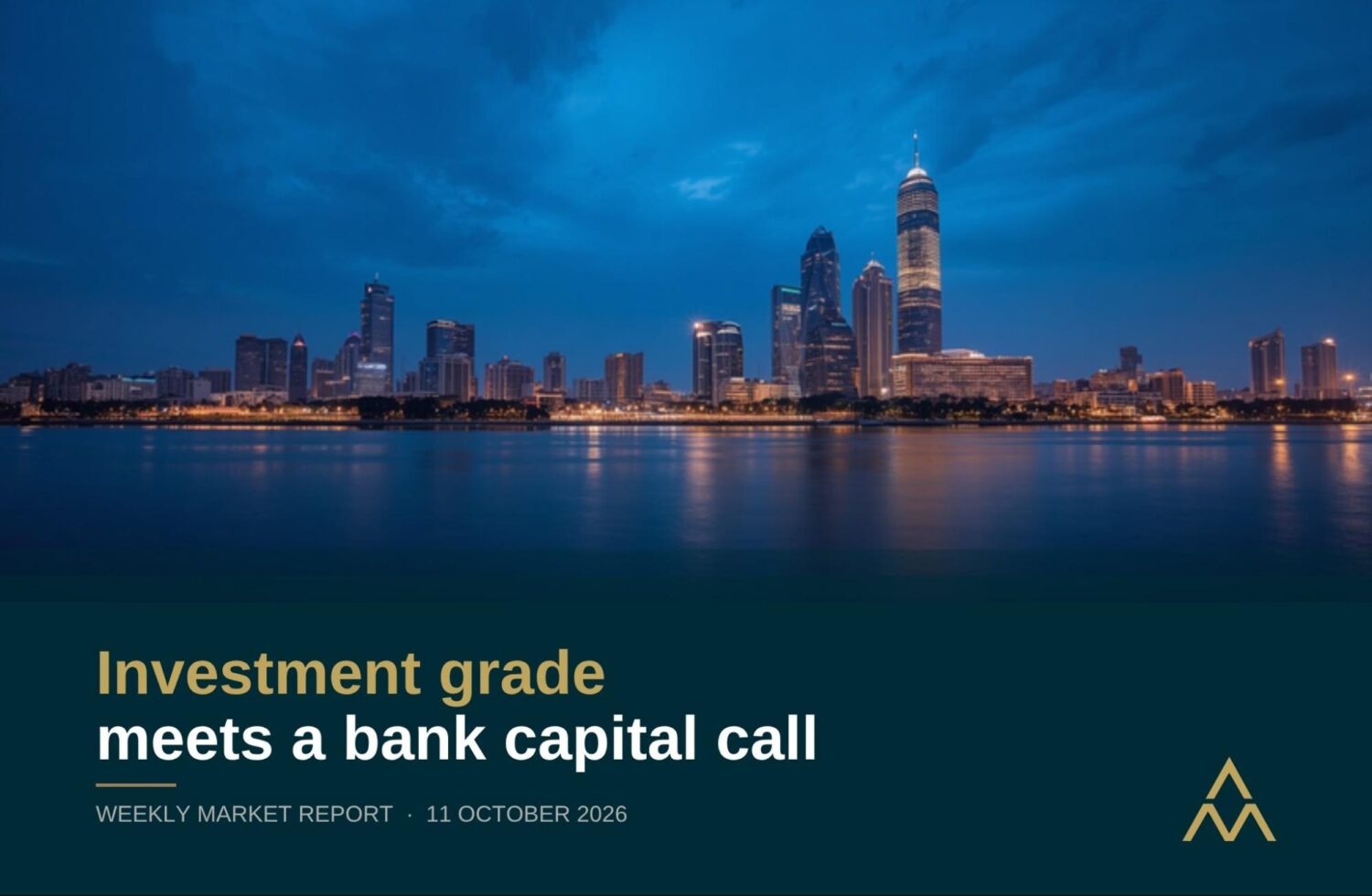
 a modern financial district. Not a location or institution named in the text.
On 8 October, Japan’s Rating and Investment Information (R&I) raised Vietnam’s foreign-currency issuer rating from BB+ to BBB-, with a stable outlook. It is the first investment-grade rating assigned to Vietnam by any agency. R&I cited growth ahead of Southeast Asian peers, the reform agenda, a 2025 budget deficit of 3.3% of GDP and public debt of just over 30% of GDP. It also listed the weak points: bank loans above 140% of GDP, tight banking liquidity as credit outpaces deposits, large real-estate exposure, somewhat limited capital buffers and foreign-exchange reserves covering less than three months of imports.
Two other external signals followed. On 9 October the EU’s Ecofin Council moved Vietnam from Annex I of its list of non-cooperative tax jurisdictions, to which it had been added in February 2026, to the Annex II watch list. On 6 October the World Bank raised its 2026 growth forecast for Vietnam by 1.1 percentage points to 7.4%, with inflation expected to average 4.2%.
The listed market did not respond in kind. The VN-Index fell for a third consecutive week, by 0.15% to 1,735.09, and foreign investors recorded a weekly net sale on the Ho Chi Minh Stock Exchange (HOSE) of about VND13.5–14.0 trillion.
Developments in Vietnam: banks line up equity
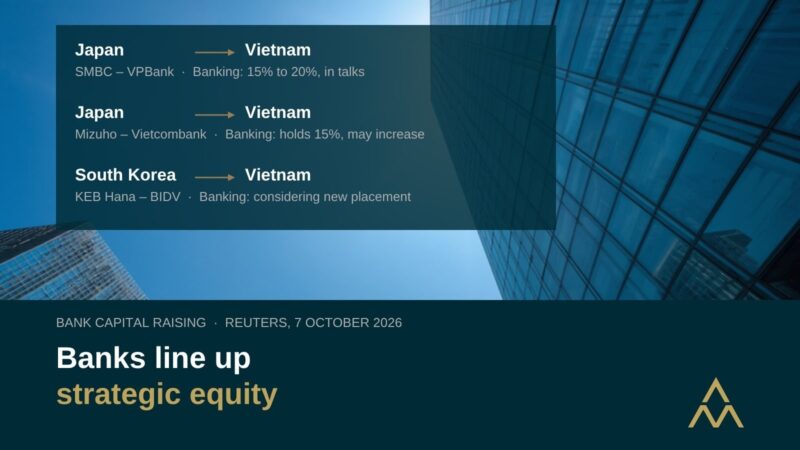 annotated with the bank stake discussions reported this week.
Reuters reported on 7 October that Vietnamese banks plan share sales of nearly US$7 billion by the end of 2027, based on public disclosures and a Fitch Ratings report. Fitch described it as likely the largest wave of bank capital raising in the country’s history. The main components reported were:
- VPBank: a private placement worth about US$560 million at current prices, with Japan’s SMBC in talks to raise its stake from 15% to 20%.
- Vietcombank: a sale of 6.5% of its shares by year-end, worth about US$1.2 billion. Minutes of an April shareholder meeting state that Mizuho, which holds 15%, “may potentially increase” its holding.
- BIDV: after placing about 3% in March, a plan to sell almost 11% more by end-2027; Korea’s KEB Hana, its largest foreign shareholder, is considering the new plan.
- HDBank: a 10.7% stake sale by end-2027. Techcombank has discussed a stake sale with foreign lenders.
Foreign ownership of Vietnamese banks is capped at 30% in aggregate and 20% for a single investor, with three lenders, VPBank and HDBank among them, allowed to go to 49%.
The demand side is visible in the data. System credit grew 11.59% between the start of the year and 30 September, according to the Vietnam Banks Association. The State Bank of Vietnam’s Circular 50/2026, effective 1 December according to MBS research cited by The Investor, will allow banks that register early for the Basel III liquidity ratios (LCR and NSFR) to use a 95% loan-to-deposit ceiling instead of 85%; all banks must meet both ratios from October 2028. Separately, SHB received approval to raise its charter capital to VND53,442 billion and to proceed with an international bond.
Strategic consolidation was also evident outside banking. Masan Group registered, through a wholly owned subsidiary, to buy up to 73 million shares of Masan Consumer (HOSE: MCH), about 5.6%, which would lift its holding from about 69.4% to about 74.9%. On 9 October, around 64 million MCH shares worth roughly VND9.6 trillion changed hands in negotiated trades sold by foreign investors, which accounts for most of the week’s unusually large foreign net sale.
Regional angle
 Tokyo skyline at dusk. Japanese and Korean groups featured among this week’s strategic investors.
The investors named in the bank pipeline are Japanese and Korean, and the pattern extended to other sectors. Nippon Paint agreed to buy AkzoNobel’s decorative paints business in Vietnam, Indonesia, Malaysia, Thailand, Singapore, Papua New Guinea and Australia at an enterprise value of about US$1.35 billion, roughly 21 times 2025 EBITDA, with most markets expected to close by mid-2027. Korea’s LS Eco Energy said it would take 58% of a new samarium-metal producer in Ho Chi Minh City, according to The Investor.
Elsewhere in the region, the Philippines’ Mynt, parent of GCash, ran its public offer from 6 to 12 October ahead of a 20 October listing, and Hong Kong IPO proceeds for January to September more than doubled year on year to HK$388 billion.
Implications for investors and companies
The rating matters most for the cost and structure of foreign capital, not for this week’s share prices. One investment-grade rating from a single agency does not change index eligibility or most institutional mandates. If other agencies follow, however, the effect could reach offshore bond and loan pricing for banks and large issuers, and with it the financing assumptions in cross-border transactions.
Bank equity is likely to be the largest source of strategic deal flow in the near term. With credit up almost 12% in the first nine months and liquidity rules tightening towards 2028, banks need equity, and the foreign-ownership caps make each percentage point of available room a negotiated asset. Lenders without an established foreign partner may face a choice between strategic placements and broader, more price-sensitive offerings.
Headline foreign flows need to be read alongside the transactions behind them. This week’s large net sale was largely one strategic transfer. Sellers and boards using market data as a reference point in negotiations may benefit from separating portfolio flows from strategic transfers.
Risks are stated by the rating agency itself. Bank leverage, real-estate exposure and modest reserves are the same issues buyers will examine in due diligence, and they are likely to shape pricing as much as the rating itself.
What to watch
- Whether other rating agencies review Vietnam’s sovereign rating, and any offshore sovereign bond plan.
- Progress on the VPBank, Vietcombank and BIDV placements, and any foreign-ownership room changes.
- The National Assembly session opening on 17 October, including the Investment Law and Electricity Law amendments.
- Completion of Masan’s MCH purchase, registered to run until 23 October.
- Mynt’s listing on 20 October as a reference for regional fintech exits.
- The EU’s next review of its tax list, scheduled for February 2027.
Alliance Mount will continue to follow how ratings, bank capital and strategic investment shape transactions in Vietnam and the wider region.