

Vietnam reported its fastest quarterly growth in four years and its highest nine-month FDI disbursement in five years in the same week that foreign portfolio investors kept selling listed equities. The contrast was sharpest in M&A, where strategic buyers from Japan, the United States and Hong Kong moved transactions from signing towards funding and completion.
What changed this week
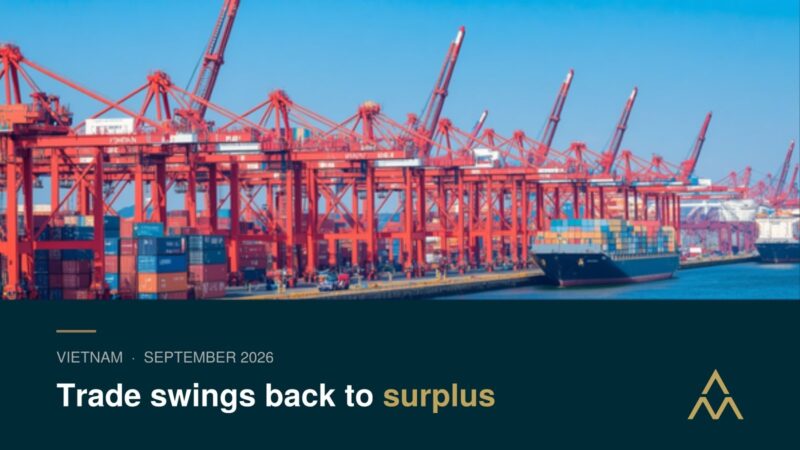 Container terminal. September brought Vietnam’s first monthly trade surplus of 2026.
Data released by the National Statistics Office (NSO) on 3 October show GDP growth of 9.95% year on year in the third quarter and 9.01% for the first nine months of 2026. Registered FDI reached US$50.36 billion over nine months, up 76.4%, while disbursed FDI rose 12.1% to US$21.07 billion, the highest nine-month level in five years. September also produced a trade surplus of US$1.27 billion, the first monthly surplus this year.
Within those figures, the M&A channel expanded strongly. Capital contributions and share purchases by foreign investors reached US$6.97 billion across 2,335 transactions, up 44% year on year, alongside US$29.24 billion for new projects and US$14.15 billion in capital increases.
The listed market moved the other way. The VN-Index fell 2.66% over the week to 1,737.71, a second consecutive weekly decline, and foreign investors were net sellers on the Ho Chi Minh Stock Exchange (HOSE) in every session, by roughly VND4.9–5.0 trillion in total according to Vietstock and CafeF. Exchange-traded fund flows in the first week after the FTSE upgrade were close to flat, according to fund-flow data.
Developments in Vietnam: from signing to closing
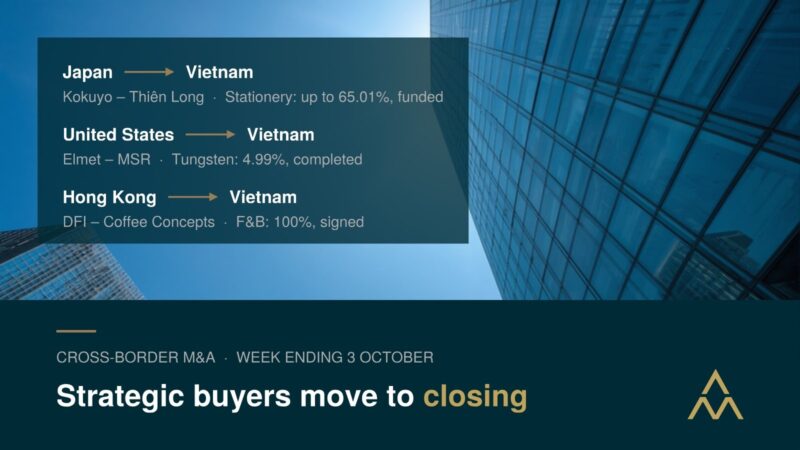 Office towers, annotated with the cross-border transactions reported this week.
Three cross-border transactions advanced during the week.
- Masan High-Tech Materials (UPCoM: MSR). The Investor reported that The Elmet Group (Nasdaq: ELMT) completed its purchase of a 4.99% stake on 1 October through a negotiated trade at VND58,800 per share, or VND3.24 trillion (US$124.8 million) in total. MSR also set out a roadmap towards a HOSE listing, with a filing targeted for 2027.
- Thiên Long Group (HOSE: TLG), a stationery maker. Kokuyo’s board approved JPY28 billion (about US$177 million) of funding on 30 September for its Singapore vehicle, Synergy Investing ASIA. The vehicle is to acquire Thiên Long An Thịnh, which holds 46.82% of TLG, and then launch a tender offer for up to a further 18.19%, for a combined stake of up to 65.01%. The tender timetable has not been announced.
- Starbucks in Vietnam. DFI Retail Group and Hongkong Caterers announced a reorganisation of their Maxim’s joint venture on 30 September. DFI will take ownership of Coffee Concepts, the Starbucks licensee operating more than 1,100 stores across seven Asian markets including Vietnam. Completion is expected by the end of the first quarter of 2027; DFI’s announcement did not disclose a consideration.
Domestic groups were also active. Hòa Phát Group (HPG) completed a subscription for 25.13% of Tập đoàn Tương lai Sông Hồng (Song Hong Future Group), which is developing an urban area of about 696 hectares in Đông Anh, Hanoi. HPG paid in kind with shares in its own real-estate subsidiary; reported values range from about VND8.0 trillion to VND9.9 trillion depending on the source.
On policy, the Government presented a draft revision of the Law on Investment (Luật Đầu tư) to the National Assembly Standing Committee on 1 October. It proposes wider market access for foreign investors and a shift from traditional tax incentives towards performance-based support. The National Assembly session opens on 17 October. Separately, Decree 342/2026/ND-CP on goods trading by foreign investors takes effect on 18 October; it requires domestic companies that take in foreign capital to obtain new business licences within 12 months.
Regional angle
 Electronics manufacturing line
Regional manufacturers committed fresh capital to Vietnam. Samsung Electro-Mechanics announced KRW6.78 trillion (about US$4.9 billion) of investment in AI chip-package substrates, of which KRW2.51 trillion (about US$1.8 billion) is earmarked for expanding its existing Vietnam plant by April 2028, according to TechNode Global and the Korea Herald. Pandora opened a US$150 million jewellery plant in Ho Chi Minh City on 1 October, its first production site outside Thailand. By source country, Singapore (US$9.26 billion) and South Korea (US$5.70 billion) led nine-month FDI registrations, followed by Luxembourg, Hong Kong, China and Japan.
Regional exit markets were less accommodating. Mynt, the parent of the Philippine e-wallet GCash, set its final IPO price at P6.60 per share, 34% below its original P10 ceiling, with listing targeted for 20 October. In Hong Kong, three of four companies that listed on 29 September opened below their offer price, according to the South China Morning Post.
Placed in a regional context, the week suggests that capital committed for the long term continues to favour Vietnam’s production base, while public-market investors across the region remain price-disciplined.
Implications for investors and companies
Two kinds of foreign capital are responding to different signals. Portfolio investors appear to be reacting to valuations, currency and post-upgrade positioning; strategic investors appear to be reacting to growth, supply-chain relocation and access to specific assets. The week’s figures are consistent with that reading, although one week of flows is a short sample. For sellers, a weaker listed market may lower the public comparables used in negotiations even where strategic interest is firm.
Execution is now a larger share of the work. The MSR, TLG and Starbucks transactions each illustrate a different closing path: a negotiated block trade, a funded offshore vehicle followed by a tender offer, and a regional reorganisation with a long completion window. Foreign-ownership room, tender-offer rules and regulatory clearances increasingly set the timetable as much as headline price.
The regulatory calendar has become a deal variable. Transactions involving foreign entry into distribution or retail may need to plan for re-licensing under Decree 342, and incentive-led investment cases may need to be revisited as the revised Law on Investment moves through the National Assembly.
Exit routes are being repriced. Mynt’s pricing and the softer Hong Kong debuts indicate that IPO exits in the region are available, but at a discount to earlier expectations. For sponsors holding Vietnamese assets, trade sales and strategic stake sales may remain the more predictable route in the near term.
What to watch
- The National Assembly session from 17 October and the passage of the revised Law on Investment and related amendments.
- The entry into force of Decree 342/2026/ND-CP on 18 October and early guidance on re-licensing.
- Kokuyo’s tender-offer timetable for Thiên Long.
- Mynt’s listing, targeted for 20 October, as a reference point for fintech exits in Southeast Asia.
- Foreign flows on HOSE, against broker estimates that passive FTSE-related inflows will arrive mainly in 2027.
- Progress on the US–Vietnam reciprocal trade agreement, which the Ministry of Foreign Affairs said on 1 October remains under negotiation.
Alliance Mount will continue to follow how strategic capital, regulation and market conditions shape transactions in Vietnam and the wider region in the weeks ahead.