

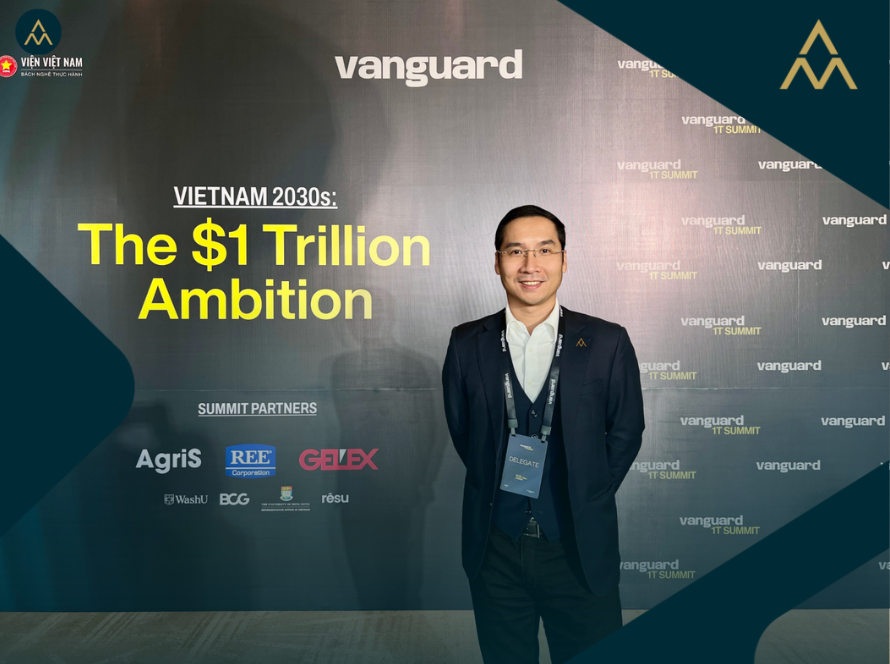
Mr. Tung HOANG, Managing Director and representative of Alliance Mount, attended the Vietnam Vanguard Summit 2026, joining policymakers, global executives, investors, and industry leaders to assess Vietnam’s strategic outlook as the global economy enters a more fragmented, risk-sensitive, and standards-driven era.
One message echoed across keynotes and panels. Vietnam’s opportunity is real, but increasingly time-bound. In the next decade, competitive advantage will belong to economies and companies that invest deliberately in fundamentals and can prove reliability, compliance, and value creation at scale.

Mr Tung Hoang – Managing Director M&A Investment of Alliance Mount
A new global baseline: uncertainty is no longer cyclical, it is structural
The macro discussions pointed to a shift that many businesses still underestimate. Historically, global uncertainty came in waves, followed by stabilization. Today, uncertainty has become the baseline because the rules of globalization are changing.

First, geopolitics has become a core economic variable. Trade and investment decisions are now influenced not only by cost and demand, but also by risk exposure, strategic alliances, and national security considerations. For businesses, this means supply chains are being redesigned around resilience and political feasibility, not only efficiency. For investors, country risk is no longer an appendix. It is at the center of underwriting.
Second, globalization is fragmenting rather than reversing. Economic integration is not collapsing, but it is reorganizing into regional corridors and preferred networks. This creates opportunities for countries that can be trusted as stable nodes, while increasing penalties for those that appear unpredictable or misaligned with global standards.
Third, technology, especially AI and semiconductors, is no longer simply a productivity lever. It has become a strategic asset subject to export controls, data sovereignty rules, and competitive state policies. This will influence where advanced manufacturing, digital services, and R&D clusters can credibly scale.
Fourth, sustainability and decarbonization are moving from corporate messaging into the operating model. Carbon-linked trade policies, ESG-linked capital allocation, and traceability requirements are becoming real constraints. Companies will face a widening gap between compliant and non-compliant supply chains, affecting access to markets, financing, and customers.
Finally, the end of cheap money changes everything. When capital is abundant, inefficiency is tolerated and growth narratives can substitute for execution. When capital becomes selective, the market rewards fundamentals: predictable cash flows, governance, risk management, and credible value creation.

Taken together, these forces redefine competitiveness as value add, reliability, and compliance, rather than low cost and fast delivery.
Global Expansion: the new requirement is institutional strength, not just ambition
In the panel Global Expansion: Leading Through Uncertainty, the discussion moved beyond the traditional market-entry playbook. The implicit message was that global expansion is increasingly less about geography and more about institutional capability.
When uncertainty becomes structural, companies expanding cross-border must answer harder questions. Can you comply across jurisdictions with different rules and enforcement intensity. Can you manage reputational risk when supply chains and data flows are scrutinized. Can you maintain operational reliability when logistics and costs fluctuate. Can your governance stand up to due diligence, partner expectations, and regulatory demands.
This elevates governance from a back-office function into a growth enabler. In practice, it means expansion leaders need stronger risk mapping, compliance systems, documentation discipline, and a more mature operating cadence. Businesses that treat governance as a cost center will struggle to scale. Those that treat it as infrastructure will be able to access better partners, better markets, and better capital.

Vietnam Between Giants: the strategic premium is trust, not positioning

The session Geopolitics of Growth: Vietnam Between Giants reinforced a crucial point. Vietnam’s strategic location and growing relevance are not enough on their own. In a world of geopolitical rivalry, trust becomes a premium asset.
Vietnam is well positioned to benefit from supply chain diversification, but the sustainability of that benefit depends on whether Vietnam is perceived as predictable in policy and execution, credible in compliance and enforcement, and consistent in its engagement with global partners.
This is not merely a diplomatic theme. It directly impacts investment flows. Multinationals and institutional investors will increasingly build confidence thresholds into their decision frameworks: regulatory clarity, dispute resolution, data reliability, and the ability to run compliant operations at scale.
Vietnam’s growth story in the next decade will be shaped by how effectively it can translate opportunity into institutional trust across trade, investment, and governance.
Ho Chi Minh City and the Vietnam IFC: Finance is the output of an ecosystem
The framework for a Vietnam International Financial Centre in Ho Chi Minh City was particularly instructive because it framed finance not as a standalone industry, but as an output of an ecosystem.

The proposed four offerings are International Capital Markets, International Trade Finance, Digital Banking and FinTech, and niche specializations such as commodities and green finance. The deeper insight is in the enablers.
Talent and urban livability determine whether high value functions can relocate and remain. Trusted institutions and professional services determine whether markets can function with confidence. A business-friendly environment and incentives determine whether the ecosystem can reach critical mass. Internationally aligned legal and regulatory frameworks determine whether global participants can operate without interpretation risk.
An IFC cannot be willed into existence through branding. It must be built through credible institutions, human capital, and rule-based systems that global capital can trust.
Talent: Vietnam’s most strategic constraint and its most scalable advantage
The talent discussion acknowledged an uncomfortable reality. Vietnam can attract investment, but sustaining the shift to higher value added activity depends on whether it can produce and retain talent at scale.
The challenge is not only quantity. It is capability depth. Engineers who can work in standards-driven environments. Managers who can run complex operations and compliance requirements. Leaders who can communicate globally and execute cross-border strategies.
Talent is not a support function. It is a strategic input, similar to power capacity or logistics infrastructure. Countries that win the next decade will be those that can scale talent pipelines while upgrading quality and connect education, corporate training, and industry needs into a coherent system.

New markets and opportunities: growth will come with higher standards and longer timelines
The panel New Markets, New Opportunities: Vietnam’s Next Decade broadened the lens across sectors. The deeper pattern is that the next wave of growth is increasingly tied to healthcare demand and demographic shifts, the modernization of agriculture and food value chains, industrial real estate and supply chain infrastructure, and power and the transition to cleaner energy.
These opportunities come with two realities.
Standards are rising. Investors and global partners require transparent governance, traceability, and long-term compliance readiness. Timelines are longer. Real value creation in these sectors requires patient capital, multi-year execution, and institutional capability, not short-term trading logic.
This is a meaningful shift for Vietnam’s business ecosystem. Success will increasingly depend on the ability to run long-duration projects with disciplined governance and credible capital structures.

Conclusion: Vietnam’s opportunity is real, but it must be built deliberately
Across keynotes and panels, the Summit’s conclusion can be summarized in one strategic sentence.
Vietnam will win the next decade by competing on value, reliability, and compliance, supported by investment in technology, power, logistics, and talent.
The opportunity is real. Yet it will not unfold automatically. It will be shaped by deliberate choices and disciplined execution from policymakers, investors, and business leaders.
Alliance Mount continues to work with investors and corporates on capital strategy, M&A, and value creation, particularly as governance, resilience, and cross-border credibility become central to expansion decisions.