


Japan’s Kokuyo has completed its indirect purchase of nearly 47% of stationery maker Thiên Long Group, and the founder-chairman and four fellow directors have resigned ahead of a tender offer. In the same week Sojitz took two board seats at Taseco Airs, and official data showed foreign purchases of existing shares reaching US$4.71 billion in ten months.
What changed this week
Kokuyo, the Japanese office-products group, completed the purchase of 100% of Thiên Long An Thịnh Investment JSC, the largest shareholder of listed stationery maker Thiên Long Group (TLG), the company announced on 6 November. The holding company owns about 45.2 million TLG shares, or 46.82% of charter capital, according to VnExpress and Tuổi Trẻ News. The second step announced in December 2025 is a public tender offer for a further 18.19%, which would lift Kokuyo’s position to 65.01% and make TLG a subsidiary; Vietstock reported that price and timing have not yet been announced.
The governance change is moving in parallel. Founder-chairman Cô Gia Thọ and four other board members submitted resignations on 4 November, and an extraordinary general meeting (EGM) on 7 December will consider their dismissal and elect five new directors, with the departures taking effect from 1 January 2027. Tuổi Trẻ News reported that Mr Thọ will become honorary chairman for three years under a consultancy contract, with no management role or board voting rights, and with non-compete obligations that run for two years after the contract ends.

Illustrative image: an open notebook and pencils on a desk; not a product of any company named in this report. Photo: Clay Banks / Unsplash.
A second Japanese group moved from shareholder to director. At the 6 November EGM of Taseco Airs (AST), an airport-services company, shareholders elected Sojitz nominees Hisashi Teshigahara and Tomohiro Ota with about 99.37% of votes, CafeF reported. They replace directors who represented the funds PENM and STIC, from which Sojitz bought 27.64% in September for about VND1,053 billion. Taseco Group keeps control with 51%.
Developments in Vietnam
Foreign buyers are acquiring existing shares at pace. Ministry of Finance data reported by VnEconomy show foreign capital contributions and share purchases of US$7.99 billion across 2,616 transactions in the first ten months of 2026, up 49.6% year on year. Of this, US$4.71 billion across 1,788 transactions bought existing shares without adding charter capital, the channel closest to M&A. Total registered foreign direct investment (FDI) reached US$54.85 billion, up 74% and the highest for the period since 2009, while disbursed FDI rose 13.1% to about US$24.08 billion.
Listed markets told a different story. The VN-Index fell 0.93% over the week to 1,725.36, its second weekly decline, according to Vietstock. Foreign investors sold a net VND869 billion of shares on the Ho Chi Minh Stock Exchange (HOSE), down by about two-thirds from the previous week, with the heaviest selling in banks: MB (MBB), Vietcombank (VCB) and ACB, Tin nhanh Chứng khoán (Securities Investment newspaper) reported.
The state has drawn the perimeter of what it keeps. Decision 2054/QĐ-TTg, signed on 27 October by Deputy Prime Minister Nguyễn Văn Thắng and detailed during the week, sets state-ownership targets to 2030 for large enterprises, Báo Đấu thầu (Bidding newspaper) and Reuters reported. Vietcombank (74.8%) and BIDV (76.73%) may fall to no less than 65%, VietinBank moves from 64.46% to 65%, the Vietnam National Shipping Lines (VIMC) falls from 99.469% to 65% and the Vietnam Rubber Group from 96.77% to 75%. The state’s direct holding in Vietnam Airlines rises from 39.29% to 86.42%. The decision does not specify how the targets will be reached.
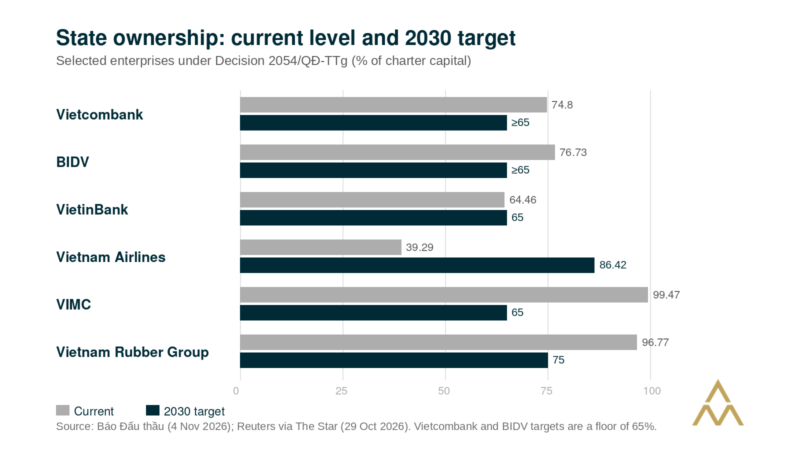
State ownership in selected enterprises: current level and 2030 target under Decision 2054/QĐ-TTg. For Vietcombank and BIDV the target is a floor of 65%. Sources: Báo Đấu thầu; Reuters via The Star.
Policy direction on foreign ownership is opening, carefully. On 7 November the National Assembly passed the 2027 socio-economic plan, targeting growth of at least 10% and asking the Government to expand foreign ownership limits soon in sectors that do not affect national security, VnExpress reported. Five days earlier, deputies debated amendments to the Law on Investment (Luật Đầu tư), including market-access conditions for foreign investors and sensitive defence and security sectors. Finance Minister Ngô Văn Tuấn said disbursed FDI must average US$30–40 billion a year and that special incentives should be tied to measurable outcomes, the Vietnam News Agency reported. The law has not yet been passed.
Regional angle
The Umeda Sky Building in Osaka. Photo: Dmitry Romanoff / Unsplash.
Japanese groups were the most visible acquirers this week, although Japan ranked only sixth by newly registered FDI over ten months, at US$1.58 billion, behind Singapore (US$9.52 billion), South Korea (US$5.81 billion), Luxembourg, Hong Kong and mainland China. In Alliance Mount’s reading, the contrast suggests that Japanese capital is arriving increasingly through acquisitions and board positions in established companies rather than through new projects. Separately, The Investor reported that Malaysia’s Gamuda Land and Japan’s Hankyu Hanshin Properties signed a strategic partnership for Norton Park, a 7.9-hectare residential project in Ho Chi Minh City; the equity split was not disclosed.
The external backdrop was mixed. The Reserve Bank of Australia raised its cash rate by 25 basis points to 4.85% on 3 November, while Bank Negara Malaysia held its policy rate at 2.75% on 5 November. At home, the State Bank of Vietnam offered a six-month USD/VND swap of up to US$2 billion, the longest tenor it has used for this instrument, to provide longer-term dong funding and help lower interbank and deposit rates, Vietstock reported.
Implications for investors and companies
Control often arrives in steps. Buying a founder’s holding company first and tendering for the balance afterwards lets a buyer secure a blocking position before it makes a public offer. For owners of listed family companies, the structure of the holding layer can matter as much as the listed share price in how a transaction is designed.
The founder transition is part of the deal. An honorary role without voting rights, a consultancy contract, a non-compete period and a fixed date for a new board are terms that both sides negotiate, not afterthoughts. Sellers who plan their own role early tend to keep more leverage over timing.
Minority stakes can carry real governance. Sojitz holds 27.64% of Taseco Airs, well short of control, yet now has two directors. Investors entering below 50% may reasonably expect board representation, and controlling shareholders should be ready to negotiate shareholder agreements and reserved matters accordingly.
The state’s perimeter is clearer, and it implies supply. Floors of 65% at Vietcombank and BIDV, and lower targets at VIMC and the Vietnam Rubber Group, define where state stakes could be offered over the next four years. The method and pace remain open, so strategic investors interested in these assets would be prudent to follow the implementation detail rather than the headline targets alone.
Foreign selling of listed shares and foreign buying of companies are not contradictory. Portfolio investors are trimming bank positions while strategic buyers pay for control and influence. In Alliance Mount’s view, valuations for private and mid-cap control transactions are likely to be set by these strategic buyers’ views of long-term value rather than by index sentiment.
What to watch
- The price and timetable of Kokuyo’s tender offer for Thiên Long Group, and the 7 December EGM.
- Final National Assembly votes on the Investment, Securities and related laws before the session closes on 21 November, and any detail on foreign ownership limits.
- How Vietcombank and BIDV approach the 65% floor: share sales, placements or new issuance.
- Grant Thornton’s October M&A data and the ASEAN Summit on 16–18 November.
Alliance Mount will continue to follow how strategic buyers, state ownership policy and governance transitions are shaping control transactions in Vietnam.