



For the second time in five weeks, the state’s controlling stake in Seaprodex drew no registered bidders at a starting price more than twice the market. In a week of the heaviest monthly foreign selling of the year, the transactions that did close were negotiated, with buyer and seller agreeing on price before regulators signed off.
What changed this week
The Hanoi Stock Exchange (HNX) cancelled the 2 November auction of 79,228,000 shares in Seaprodex (SEA), a 63.38% stake held by the State Capital Investment Corporation (SCIC), after no investor registered or paid a deposit by the 26 October deadline, Tin nhanh Chứng khoán (Securities Investment newspaper) reported. The lot’s starting price was VND8,509.1 billion, or about VND107,400 per share. SEA closed at about VND48,100 on 28 October. The first attempt, scheduled for late September, was cancelled on 29 September for the same reason.
The wider market offered little support. The VN-Index fell 32.53 points, or 1.83%, over the week to 1,741.62, in what Vietstock described as a failed recovery attempt. Foreign investors sold a net VND2,692.3 billion of shares on the Ho Chi Minh Stock Exchange (HOSE) during the week, and about VND20,844 billion across all three trading venues in October, the largest monthly net sale of 2026, according to Tin nhanh Chứng khoán. A single stock, Masan Consumer (MCH), accounted for about VND9,602 billion of the October total.
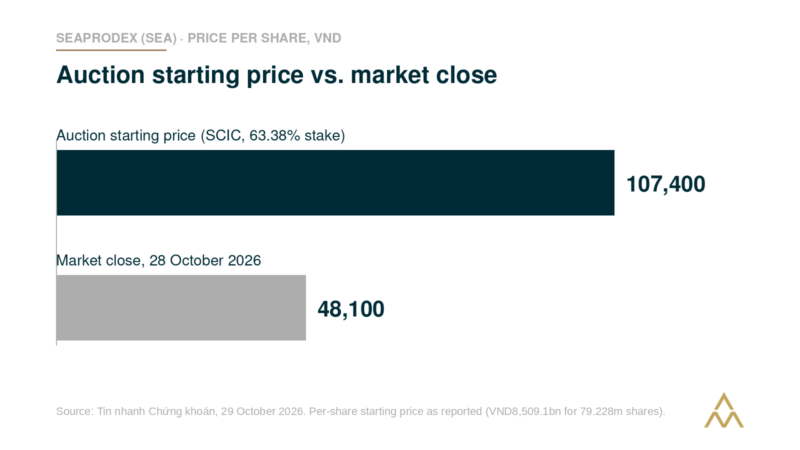
Seaprodex (SEA): auction starting price per share against the 28 October market close. Source: Tin nhanh Chứng khoán, 29 October 2026.
Developments in Vietnam
What sits behind the price. Seaprodex’s principal asset is the land at 2–4–6 Đồng Khởi in central Ho Chi Minh City, a 1,522 m² corner plot with three street frontages that is planned for a mixed-use building of up to 20 floors, Tiền Phong reported. The company posted net revenue of nearly VND435 billion and profit after tax of more than VND100 billion in the first half of 2026. Most of the remaining shares are held by Ngân Hiệp Real Estate (24.03%) and Redwood Investment (8.44%), both described by Tiền Phong as linked to Novaland. Neither report explains how the starting price was set.

Illustrative image: a colonial-era building at the Huế Imperial Citadel; not an asset named in this report. Photo: Elist Nguyen / Unsplash.
The policy frame is selective, not a retreat. Prime Ministerial Decision 40/2026/QĐ-TTg, in force since 5 August, sets the state ownership thresholds that guide enterprise restructuring plans for 2026–2030, Viet Nam News reported. It keeps full state ownership in areas such as essential public services and major infrastructure, at least 65% in sectors including finance and banking, airports and large-scale mining, and leaves room to reduce or withdraw state capital elsewhere.
A new rulebook for distressed state-linked assets. Decree 358/2026/NĐ-CP on the Debt and Asset Trading Corporation (DATC) took effect on 30 October, replacing Decree 129/2020. According to Tạp chí Thị trường Tài chính Tiền tệ (Financial and Monetary Market Review), it allows DATC to buy and resolve debts and assets assigned by the Government, as well as those of state-owned and other enterprises, and requires it to provision the full remaining purchase price of overdue debts within five years.
Negotiated deals continued to close. Japan’s Asahi Mutual Life Insurance completed its acquisition of 100% of MVI Life from Manulife for about US$170 million after Vietnamese authorities amended the insurer’s licence on 27 October, Vietnam Investment Review reported. The sale had been announced on 1 December 2025. MVI Life has also signed a partnership with LivWell, a Singapore-based insurtech group.
Regional angle
External conditions did not ease. The US Federal Reserve held its target range at 3.75–4.00% on 28 October, with two policymakers dissenting in favour of a quarter-point increase, and the US 10-year Treasury yield rose to about 5.04%, Reuters reported. On 30 October the Bank of Japan kept its policy rate at about 1.25% by an 8–1 vote, with one board member proposing 1.5%, and agreed to raise its annual sales of exchange-traded funds to about ¥860 billion from January 2027. The Bank of Thailand held its rate at 1.00% on 28 October and lifted its 2026 growth forecast to 2.4%.
Tokyo Station and the Marunouchi business district. Photo: Dominic Kurniawan Suryaputra / Unsplash.
Regional deal data show a similar pattern of fewer but larger transactions. Speeda’s third-quarter review counted about US$18.9 billion of M&A in Southeast Asia, up 6.3% on the previous quarter, across 180 transactions, down 22.1% and the lowest quarterly count in its tracking since the second quarter of 2021. Deals in which both buyer and target were in the region made up 80% of value, and Singapore about 75.5%.
In Alliance Mount’s reading, the week’s evidence is consistent: strategic buyers with long horizons, including Japanese financial groups, remain active, but they are selective on price and favour bilateral, negotiated processes over open auctions.
Implications for investors and companies
A starting price is a hypothesis until a buyer tests it. Demand for prime central land in Ho Chi Minh City is not obviously the constraint. A buyer of a 63.38% stake would also weigh the position of the other large holders, the time and cost of developing the site, and the listed share price. In Alliance Mount’s view, two auctions without a single registrant suggest these factors are not reflected in a starting price set at more than twice the market.
Structure may need to change before price does, or alongside it. Within the rules that govern state capital, sellers of state stakes may look at revised valuations, negotiated sales or smaller blocks. Decision 40 widens the pool of stakes that can be sold; it does not, by itself, make them easier to price.
Foreign selling creates supply, not only pressure. The year’s largest monthly outflow means sizeable positions are changing hands. Domestic strategic and family-office buyers with patient capital may find negotiated entry points, particularly where selling reflects portfolio rebalancing rather than company fundamentals.
Regulated transactions take time, and they do complete. The Asahi–MVI Life sale took about eleven months from announcement to licence amendment. For financial-services and other licensed targets, buyers and sellers would be prudent to plan timetables and conditions precedent around regulatory review rather than market windows.
The read-across for private owners. An asking price anchored to an asset value the market has not tested can stall a process. Independent valuation and early, discreet price discovery among a small group of qualified buyers usually shorten it.
What to watch
- The National Assembly’s plenary debate on amendments to the Law on Investment (Luật Đầu tư) on 2 November, following the 28 October debate on Securities Law amendments, which covered a controlled testing mechanism and fewer conditions for securities offerings.
- Whether SCIC revises the Seaprodex starting price or changes the sale method.
- New listings as a test of domestic demand for equity, including DatViet VAC’s planned HOSE debut on 2 November and HD Securities’ planned fourth-quarter IPO.
- October macroeconomic data from the National Statistics Office, due in early November, and the ASEAN Summit on 16–18 November.
- Whether foreign net selling slows in November as US yields and the dollar settle.
Alliance Mount will continue to follow how state divestment, foreign portfolio flows and negotiated strategic transactions shape pricing in Vietnam’s deal market.