



The State Bank of Vietnam this week pushed banks to lower deposit and lending rates, and equities rebounded sharply. The same directive tightened bank lending for share and capital-contribution purchases, while a run of private placements showed equity, rather than debt, filling capital gaps in banks and consumer companies.
What changed this week
On 18 October 2026 the State Bank of Vietnam (SBV) issued Official Letter 9608/NHNN-CSTT, asking credit institutions to cut listed deposit rates by at least 0.5 percentage points a year on terms of six months or longer, and to lower lending rates by 1.5 to 2 points for production, business and priority sectors, Thời báo Tài chính Việt Nam (Vietnam Finance Times) reported. Banks that do not comply may see their remaining 2026 credit growth limits reviewed and their 2027 limits lowered. A second letter, 9736/NHNN-CSTT of 21 October, requires each bank to cut its average rate on new deposits of six months or more by at least 0.5 points against its own 11–20 October average.
Less noticed, but more directly relevant to transactions, the 18 October letter also asks banks to tightly control loans used to pay capital contributions or to buy stakes in limited liability companies and in joint stock companies not registered for trading on UPCoM, as well as loans for contributions to projects not yet legally eligible to operate.
The equity market responded quickly. The VN-Index rose 68.24 points, or about 4%, over the week to close at 1,774.15 on 23 October, Vietstock reported. Foreign investors remained net sellers, but at about VND968.5 billion on the Ho Chi Minh Stock Exchange (HOSE), their net sales fell by roughly two-thirds in value from the previous week.
Developments in Vietnam

Liquidity and rates. The SBV paired its guidance on retail rates with a tighter hand in the money market. It drained a net VND9,868 billion through open market operations during the week, after a net injection the week before, leaving outstanding OMO balances at about VND95,065 billion, the lowest in more than a year, Thời báo Tài chính Việt Nam reported. The overnight interbank rate eased to 4.31% on 22 October, and the central exchange rate edged down to VND25,627 per US dollar.
Equity is doing the heavy lifting. Several issuers moved private placements forward:
PNJ (Phú Nhuận Jewelry), whose shareholders met on 21 October, approved a private placement of up to 550 million shares to raise about VND8,000 billion, with a one-year lock-up, between the fourth quarter of 2026 and the second quarter of 2027. Management expects a 2026 loss of more than VND6,000 billion, largely from provisions; under current rules, that loss prevents a public offering to existing shareholders, Tin nhanh Chứng khoán reported.
Nam A Bank plans to sell 100 million shares at VND13,200 each, about VND1,320 billion, to seven professional investors, including Korean-managed and domestic fund managers. About 71.4 million shares are earmarked for foreign or majority-foreign buyers, lifting foreign ownership to about 4.07%.
PVcomBank named seven investors for a 300 million-share placement at VND13,628 per share, which would raise charter capital from VND9,000 billion to VND12,000 billion and leave the group holding about 32.4% of the bank, Vietstock reported.
M&A activity remains concentrated. Grant Thornton’s September digest, reported by Vietnam Investment Review, counted 30 Vietnam M&A transactions worth about US1.74billion, dominated the total; restructuring and related-party deals accounted for 70.7% of disclosed value. Outside that category, consumer and metals and mining led.
Regional angle
Vietnam’s easing runs against the direction of several neighbours. On 22 October Bangko Sentral ng Pilipinas raised its policy rate by 50 basis points to 5.50%, its fourth consecutive tightening, after September inflation reached 7.2%, GMA News reported. The Bank of Korea held its base rate at 3.00% the same day. Vietnam’s approach, administrative guidance on bank pricing combined with a liquidity drain, suggests the authorities are trying to support growth without loosening their grip on the dong.
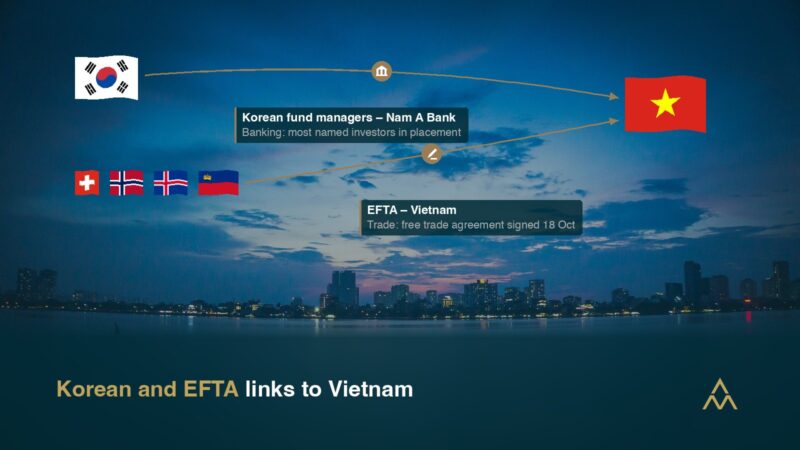
Two cross-border threads stood out. First, Vietnam and the European Free Trade Association (Switzerland, Norway, Iceland and Liechtenstein) signed a free trade agreement in Hanoi on 18 October, covering goods, services, investment, intellectual property and government procurement, Vietnam Investment Review reported. Swiss investors hold more than US$2.4 billion of registered capital in Vietnam across 234 projects. Second, Korean-managed funds account for most of the investors named in the Nam A Bank placement, a reminder that Korean institutional capital is active in mid-tier Vietnamese financials.
Regional capital markets offered a mixed read. The Philippine parent of GCash, Mynt, listed on 20 October at P6.60 per share in an offering of up to about P60.9 billion including the over-allotment, the largest in the country’s history, the Philippine Daily Inquirer reported. The e-Conomy SEA 2026 report by Google, Temasek and Bain counted about US$8 billion of private digital-economy deals, with AI-focused companies taking 80% of private deployment over the last six months.
Implications for investors and companies
Financing assumptions in domestic acquisitions deserve a fresh look. If banks apply the new controls strictly, domestically financed purchases of unlisted shares and capital contributions may take longer to fund, or may need more equity, vendor financing or offshore debt. In Alliance Mount’s view, buyers and sellers in live processes would be prudent to confirm lender appetite early rather than assume it.
Cheaper operating credit and tighter acquisition credit can coexist. Lower lending rates for production and priority sectors should help operating companies, including potential targets. The combination may favour strategic buyers with balance-sheet capacity over financially leveraged bidders.
Private placements are becoming the default recapitalisation route. When losses rule out rights issues, or when debt is expensive, issuers turn to identified investors. That can open minority entry points for funds and strategic partners, at prices negotiated against a floor set by regulation and book value.
Korean and European interest deserves early mapping. Korean fund managers in bank placements and the EFTA agreement point to counterparties that owners may not have considered. Preparation, including clean financials and clear governance, usually matters more than timing.
What to watch

How strictly banks apply the controls on lending for capital contributions and unlisted-share purchases, and whether the SBV issues further guidance.
The National Assembly’s handling of the amended Land, Housing and Real Estate Business Laws, debated on 22 October. National Assembly Chairman called for land price tables that stay close to the market without sudden spikes, VnExpress reported; changes to pricing and to charges on idle land would feed directly into project valuations.
Details of the Competition Law amendments presented on 20 October, including any change to merger-filing thresholds.
The US Federal Reserve meeting on 27–28 October and its effect on foreign portfolio flows.
The re-auction of a 63.38% stake in Seaprodex scheduled for 2 November, and PNJ’s placement pricing.
Alliance Mount will continue to follow how Vietnam’s credit policy shapes the financing, structure and timing of transactions in the months ahead.