

Asian strategic investors and lenders made sizeable commitments to Vietnam this week, while foreign portfolio investors extended their selling on the Ho Chi Minh City bourse. The divergence says less about Vietnam’s overall appeal than about which kind of capital is pricing which risk, and over what horizon.
What changed this week
In the week to 17 October 2026, three Asian corporates moved capacity or land commitments in Vietnam forward. Samsung Electronics plans to invest about VND105.79 trillion (about US$4.09 billion) in memory-chip testing facilities at Yên Bình Industrial Park in Thái Nguyên, a province north of Hanoi, according to The Korea Herald. Fukang Technology, the Foxconn unit that assembles Apple devices in Bắc Ninh, has more than doubled its charter capital to over VND17,464 billion (about US$710 million). The city of Đà Nẵng approved Thailand’s WHA Group as investor in a 400-hectare industrial park worth more than VND2.7 trillion (about US$105 million).
Over the same five trading sessions, the VN-Index fell 1.68% to 1,705.91, its fifth consecutive weekly decline, according to Vietstock. Foreign investors were net sellers of about VND3,008 billion on the Ho Chi Minh Stock Exchange (HOSE), with financial stocks among the most heavily sold.
Developments in Vietnam
 Illustrative image: electronics assembly line. Photo: Louis Reed / Unsplash.
Industrial capital. According to The Korea Herald, about 63% of Samsung’s planned investment will come from earnings of its Vietnamese operations, with the first production line due in the fourth quarter of 2027 and a second in 2028. The same report says Samsung Electro-Mechanics plans KRW2.51 trillion of substrate capacity in Vietnam. Fukang’s charter capital previously stood at VND8,346 billion. WHA’s first 200-hectare phase in Đà Nẵng is scheduled for the fourth quarter of 2027 to the fourth quarter of 2030.
Financial capital. Krungsri (Bank of Ayudhya), the Thai bank majority-owned by Japan’s MUFG, completed its purchase of the remaining 50% of SHB’s consumer finance arm on 15 October, taking full ownership of the business now renamed SFinance. The transaction was agreed in 2021, and the first half transferred in 2023, according to FintechObserver. SHB (Saigon–Hanoi Commercial Joint Stock Bank) also issued SGD229 million of bonds in Singapore in two tranches: a three-year tranche at 2.9% and a five-year tranche at 3.15%. The bonds carry a guarantee from the Credit Guarantee and Investment Facility (CGIF), a trust fund of the Asian Development Bank, and S&P Global Ratings has assigned them an AA rating, according to SHB. CafeF reported that SHB also signed a US$340 million syndicated loan, with scope to increase, coordinated by the Singapore branch of Sumitomo Mitsui Banking Corporation (SMBC).
On the domestic side, bank equity supply is building. SSI Research estimates that eight banks plan about VND143,830 billion (about US$5.4 billion) of share issuance between the fourth quarter of 2026 and the end of 2027.
Policy backdrop. At the US–Vietnam Business Summit on 14 October, Deputy Prime Minister Phạm Gia Túc said Vietnam had sent the final text of the reciprocal trade agreement to Washington; no signing date was given, TNGlobal reported. Reuters reported that Vietnam and the European Free Trade Association (Switzerland, Norway, Iceland and Liechtenstein) were due to sign a free trade agreement in Hanoi on 18 October. The government’s report to the National Assembly put nine-month GDP growth at 9.01% and registered FDI at US$50.36 billion, up 76.4% year on year.
Regional angle
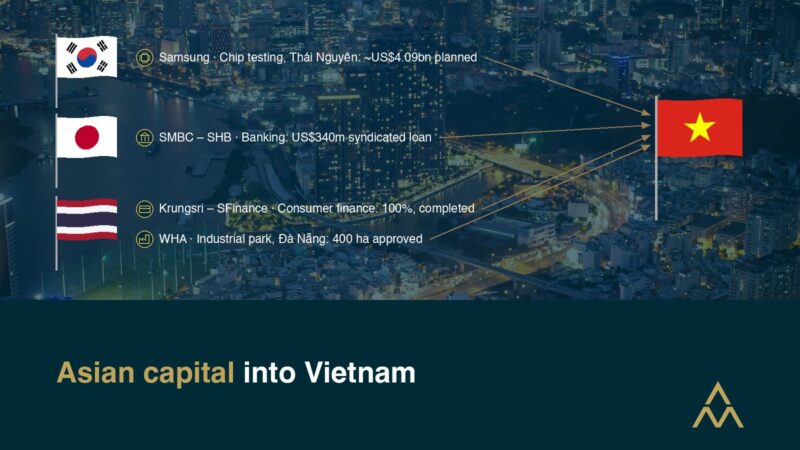 Korean, Japanese and Thai capital into Vietnam, as described in this report. Photo: CreateTravel.tv / Unsplash.
The week’s commitments came almost entirely from within Asia: Korea (Samsung), Taiwan (Foxconn), Thailand (WHA and Krungsri) and Japan (MUFG as Krungsri’s parent, and SMBC as loan coordinator). The growth comparison helps explain why. The IMF’s October World Economic Outlook, as reported by TNGlobal, projects 2026 growth of 8.4% for Vietnam, against 5.2% for Malaysia, 5.1% for Indonesia, 5.0% for Singapore and 2.1% for Thailand.
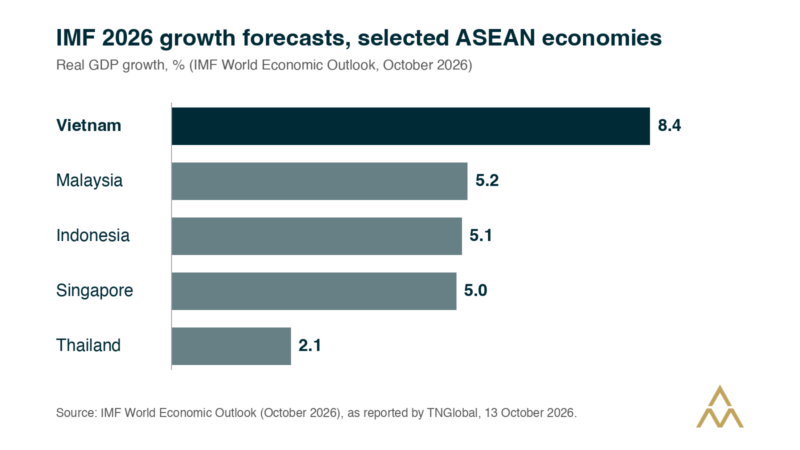
IMF 2026 growth forecasts for selected ASEAN economies. Source: IMF World Economic Outlook, as reported by TNGlobal.
Elsewhere in the region, the Monetary Authority of Singapore left its policy band unchanged on 14 October after two consecutive tightening moves. In the Philippines, the IPO of Mynt, the parent of GCash, closed its offer period on 12 October and is due to list on 20 October, according to Philstar.
In Alliance Mount’s reading, these facts point to a familiar regional pattern rather than a Vietnam-specific anomaly. Strategic investors are making long-horizon decisions about supply-chain position, tariff access and growth. Portfolio investors are responding to shorter-horizon variables: US interest rates, the dong, listed valuations and the prospect of new bank equity supply. Both can be rational at the same time.
Implications for investors and companies
Strategic buyers are widening the pool for manufacturing-adjacent assets. Large greenfield projects tend to pull in suppliers, logistics providers and industrial landlords. Owners of such businesses may find that Korean, Japanese, Taiwanese and Thai strategic parties are increasingly relevant counterparties for minority investment, joint ventures or full sales, often on terms tied to operational integration rather than listed-market multiples.
Foreign financial capital is entering through structure, not screens. The Krungsri completion, the guaranteed SHB bond and the SMBC-coordinated loan share a feature: foreign institutions are taking exposure through control, guarantees and debt rather than through minority listed stakes. For issuers below investment grade, the SHB transaction suggests that credit enhancement can open offshore funding at lower cost. The approach may be relevant beyond banks, including in acquisition finance.
Listed equity raising faces a supply test. A sizeable bank issuance pipeline is arriving while foreign portfolio demand is weak. Pricing, sequencing and the choice between rights issues and placements to identified strategic holders are likely to matter more than usual. Companies considering listed-equity raises over the next two to three quarters may benefit from preparing alternative routes.
Expect a wider gap between private and public valuations. When strategic and portfolio investors price the same market differently, negotiations over reference prices become harder. Sellers and buyers should be ready to support valuations with operating evidence rather than market comparables alone.
What to watch
 Illustrative image: container terminal. Photo: Haris Illahi / Unsplash.
- The signing date and tariff terms of the US–Vietnam reciprocal trade agreement.
- Ratification steps for the Vietnam–EFTA free trade agreement after its signing.
- The US Federal Reserve meeting on 27–28 October and its effect on US yields and foreign portfolio flows.
- The State Capital Investment Corporation’s re-auction of a 63.38% stake in Seaprodex on 2 November, with a starting price of about VND8,509 billion, as reported by CafeF.
- Bank capital raising, including regulatory approval of MSB’s rights issue and the Vietbank subscription window from 20 November to 16 December.
Alliance Mount will continue to follow how strategic and portfolio capital diverge in Vietnam, and what that divergence means for transaction structures, financing and valuation.